Company-sponsored executive coaching for leaders at a turning point.
Executive coaching for Directors through C-suite leaders, sponsored by their organization. Primarily virtual, for leaders in the US and internationally, with in-person sessions by arrangement.
When an organization sponsors coaching, everyone involved should know their part. The stages give the work discipline. The objectives, and the coaching itself, are built around the individual leader.
Claudia Beck, MCC · Former SVP, Tory Burch · Former VP, Burberry · 6,000+ coaching sessions
What the engagement includes
One-to-one development
A confidential, individual process built around one leader’s strengths, goals and working context.
Multiple perspectives
The 360 surfaces strengths, blind spots and how the leader is experienced by others.
Results for the organization
A written development plan connects the leader’s growth to how they perform and lead in the business.
Leaders whose scope has grown faster than their way of leading.
Directors, VPs, SVPs and functional Heads, and selectively C-suite executives, in complex organizations that are often global, matrixed or in the middle of change. They are already successful. The role now asks them to deliver through others.
Promotion or a larger role
A new mandate or expanded scope, where the habits that built the career start to limit it.
Executive transition coaching →Reorganization or transformation
A reorg, merger or new reporting line raises the stakes on how this leader shows up.
360 or stakeholder feedback
Feedback names a gap the leader did not expect, given their track record.
Succession and readiness
The organization wants a high-value leader ready for a larger mandate.
CEO and board exposure
More time with the CEO, the board or the executive team, and a higher standard for influence.
Leading across cultures
A leader who has relocated, or who leads inside a headquarters culture that is not their own.
The shifts the work is designed to build.
The development plan names the specific behavior shifts for each leader. These come up most often, with the change each one aims at in the organization. Results depend on the leader, the sponsor and the context.
From personal performance to performance through others
More leadership capacity, with less depending on one person.
From control to trust with clear accountability
Clearer ownership across the team.
From expertise to influence
Stronger influence across functions, where the leader does not have the final say.
From avoiding or forcing hard truths to productive truth
Issues surface earlier, and disagreement gets worked through openly.
From certainty to clarity
A team that knows the priorities and moves on them without constant direction.
From answers to curiosity
Decisions that draw on more of the team’s thinking.
Seven stages, from kickoff to wrap-up
What happens at each step, who is in the room, and what each stage produces. Stages 5 to 7 measure progress against the development plan set in stage 4.
- 1
Kickoff session
Week 1 · 90 minClient and coach- Agree the coaching objectives
- Name possible 360 contributors
- Set the cadence and full schedule
OutputAgreed objectives and calendar - 2
Alignment meeting
Within 2 weeksClient, coach, supervisor
HR if requested- Confirm objectives with the supervisor and hear their view
- Agree roles and responsibilities
- Approve 360 contributors and questions
OutputSponsor buy-in and approved 360 list
- 3
360 assessment
After alignmentCoach and contributors- Feedback gathered through interviews or the Leadership Circle Profile
- Coach debriefs the client
- The report goes to the client only
OutputConfidential 360 report and debrief - 4
Development plan
After the debriefClient and coach- Turn 360 themes into 2 to 4 development priorities
- Define specific behavior shifts
- Agree how progress will be observed
OutputWritten plan with priority outcomes and behavior shifts
- 5
Coaching sessions
Weekly to startClient and coach- Weekly at the start, then every 2 weeks
- Client arrives prepared with a focus
- Progress reviewed against the development plan
OutputApplied learning and observable progress - 6
Midpoint meeting
Halfway pointClient leads
Coach, supervisor, HR if applicable- Client presents progress and challenges
- Supervisor gives feedback on the work so far
- Define what success looks like by the end
OutputUpdated objectives for the second half - 7
Wrap-up meeting
Final monthClient leads
Coach, supervisor, HR if applicable- Client presents progress and open challenges
- Agree next steps and any ongoing support
- All parties complete the feedback survey
OutputPath forward and engagement feedback
Sponsor touchpoint with the client's supervisor
What the organization sees, and what stays private
The client owns the development. The supervisor sponsors it. We review roles together at the alignment meeting and agree how they apply to the engagement.
The sponsor sees the 2 to 4 priorities and behavior shifts from the written plan.
A direct view of progress at alignment, midpoint and wrap-up, led by the client.
Progress, next steps and any ongoing support needs.
Sessions and the 360 report stay between client and coach, within the limits of the contract and the ICF Code of Ethics. The client decides what to share.
Notice to cancel or move a session.
Recommended post-engagement progress check.
The full process and roles on two pages, to share with the leader and their supervisor.
Who does what in the engagement
Coaching works best when everyone involved knows their part.
Client
- Takes ownership of their development
- Attends sessions on the agreed schedule
- Gives 24 hours’ notice to reschedule
- Builds the 360 list and secures permissions
- Shares progress with the supervisor, including 360 results if they choose
Coach
Former SVP, Tory Burch Executive Operating Team. Accountable for sales, margin and inventory at Gap Inc., Burberry and Tory Burch, leading teams of up to 45+.
- Partners with the client on the development plan
- Runs the 360 and delivers the feedback
- Facilitates the three sponsor touchpoints
- Updates HR on progress against the development priorities, while maintaining confidentiality
- Challenges assumptions and holds the client to the priorities they set
Supervisor
- Gives the client open feedback on development areas
- Approves the 360 contributors and questions
- Sees the development priorities, not the 360 report
- Reinforces development priorities through ongoing feedback and support
- Sustains development after the engagement ends
HR / Talent Partner
- Sets out program structure and expectations
- Clarifies roles at the start
- Is the point of contact for all parties
- Helps approve the 360 contributors and questions
- Confirms a post-engagement plan is in place
Three engagements, start to finish.
Each case starts with a capable executive, a real business problem and a way of leading that had stopped working. Names and identifying details have been changed.
In their own words: what senior leaders say about the work →
Before you sponsor an engagement.
The short answers. The alignment meeting covers the detail for your organization.
How long does an engagement run?
Typically 4 to 12 months. Sessions are weekly at the start, then every 2 weeks.
Who does the coaching?
Claudia Beck, MCC, an ICF Master Certified Coach and former SVP at Tory Burch and VP at Burberry. She works with each leader directly. View the ICF MCC credential (PDF)
Do you coach leaders outside the United States?
Yes. Coaching is primarily virtual, so the leader’s location is not a constraint, and in-person sessions are possible by arrangement. Claudia has lived and worked in Austria, the United States, Japan, China and the United Kingdom, and coaches leaders based in Europe and Australia as well as the US.
How do we start?
With a thirty-minute call. If the fit is right, the engagement opens with a kickoff session, followed by an alignment meeting with the leader’s supervisor within two weeks.
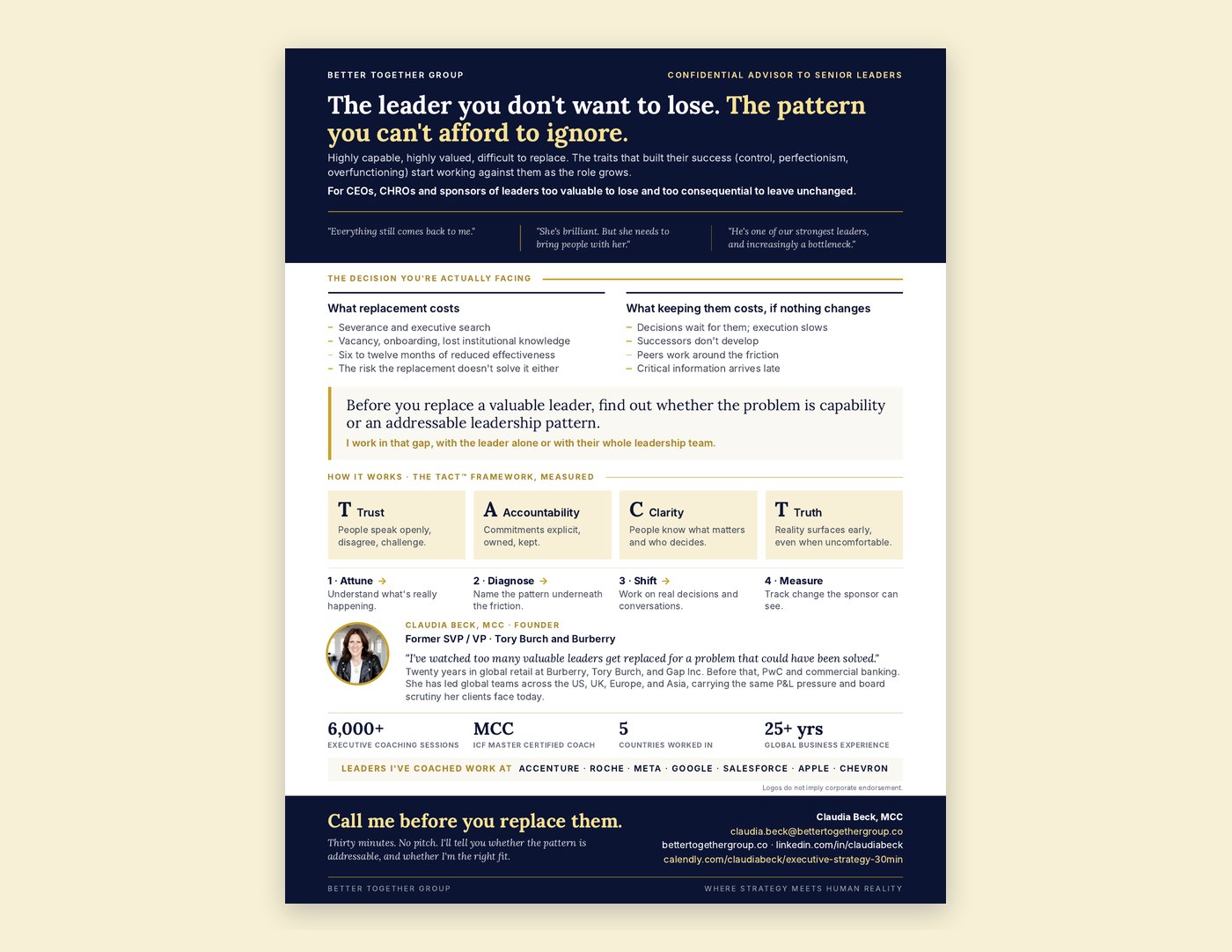
Before you replace a leader you don’t want to lose.
One page on the decision in front of you: what replacement costs, what keeping the leader unchanged costs, and how the work runs and is measured.
PDF, 1 page.
Planning a sponsored engagement?
Start with a thirty-minute conversation about the leader, the context and what the organization needs from the work. Or write to claudia.beck@bettertogethergroup.co.
For the leader’s side of the work, see Coaching & Advisory.