Where Decisions Hold After the Meeting.
I work with senior leaders and their leadership teams on how they decide, disagree and follow through, so the strategy agreed in the room still holds a week later.
The signs show up in how decisions travel.
Decisions keep coming back
The same decision returns to the agenda. More analysis, no closure, and hires or launches wait on it.
Agreement without follow-through
Everyone agrees in the meeting. By the afternoon, the version people act on is a different one.
Functions pulling apart
Each leader protects their own priorities, and budget and people go in three directions.
Concerns raised around people
Risks people already see are talked about after the meeting instead of in it, and trust thins.
A transition or a new mandate
A new CEO, a succession, an acquisition, or a strategy that has changed faster than the team has.
Everything routes to one leader
Decisions wait on the CEO or one senior executive, and the team executes instead of judging.
Strategy rarely fails on paper. It fails in the room.
We work on the decisions your team is making now.
The work starts from the decisions and tensions in front of the team, in its own meetings. Systemic team coaching over several months is the core of the work. The other formats fit specific situations, on their own or as a first step.
The core engagementSystemic team coaching
Three phases: inquiry, design and execution. It includes a Team 360, confidential interviews, observing the team in its own meetings, team sessions, and coaching in live meetings so new habits hold.
Best when: The team needs lasting change in how it decides, disagrees and follows through.
FocusedAlignment intensives
One or two days with the leadership team on a specific point of friction, such as competing priorities, unclear decision rights, or a tension the team keeps working around.
Best when: One issue is stalling the team and needs dedicated time in the room.
OffsiteExecutive team retreats
Two days away from the business to look at how the team works together, using the six ATTUNE™ Team conditions, and agree what changes when it gets back.
Best when: A new team is forming, the strategy has shifted, or the team needs a reset.
Certified programThe Five Behaviors® Team Development
Wiley’s program, built on Patrick Lencioni’s model of trust, conflict, commitment, accountability and results. I am certified to deliver it, on its own or alongside team coaching.
Best when: The team wants a research-based assessment and a shared language for teamwork.
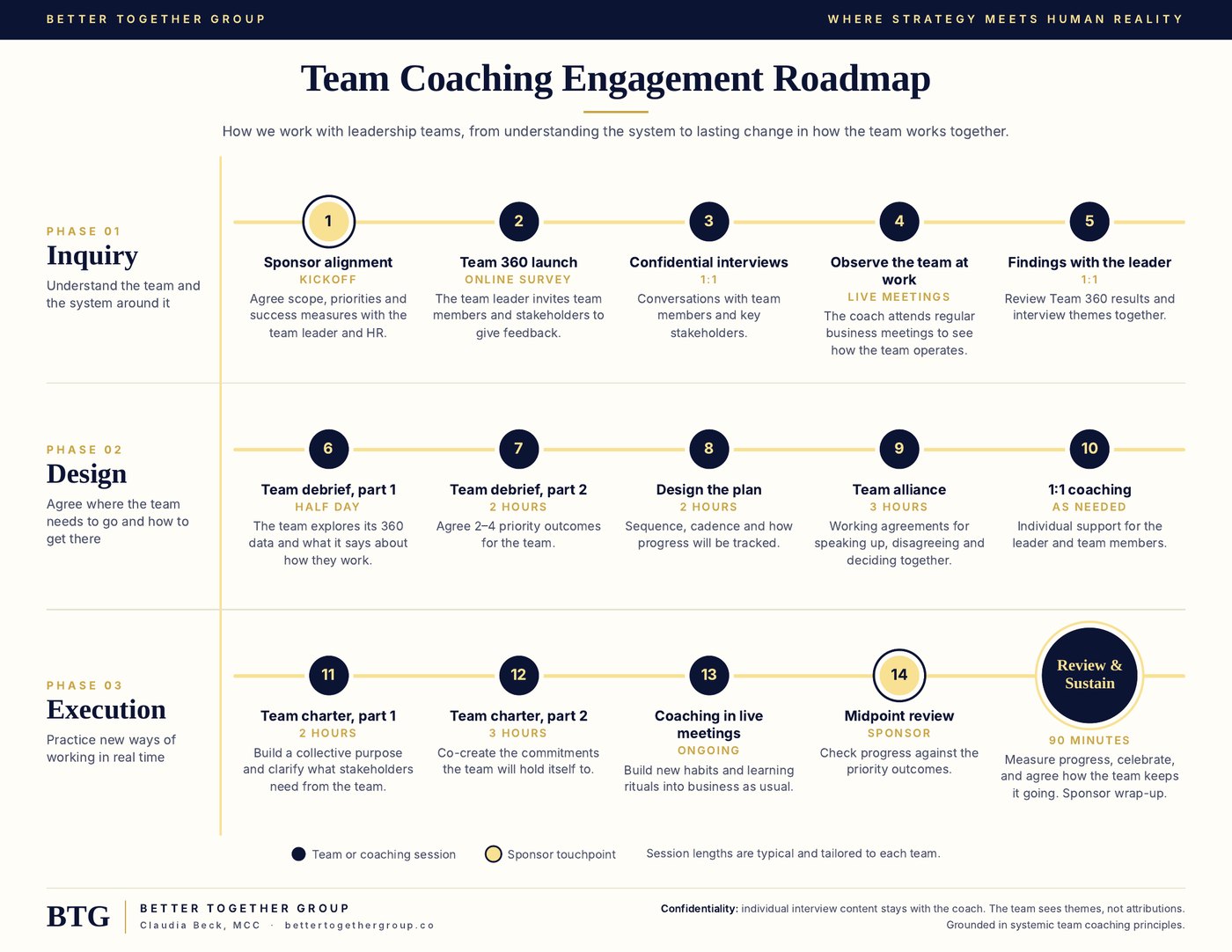
How a team engagement runs, step by step.
Three phases, inquiry, design and execution, from the first conversation with the sponsor to the final review. Session lengths are typical and tailored to each team.
Confidential interview content stays with me. The team sees themes, not attributions.
PDF, 1 page.
The Five Behaviors® is a registered trademark of John Wiley & Sons, Inc.
The ATTUNE™ Framework: from how one leader leads to how the team delivers.
ATTUNE™ Leader
How I lead
- AAwareness
- TTone
- TTrust
- UUnderstanding
- NNaming
- EEquilibrium
TACT™
The climate I create
- TTrust
- AAccountability
- CClarity
- TTruth
ATTUNE™ Team
How we operate together
- AAlignment
- TTrust
- TTruth
- UUnderstanding
- NNavigation
- EExecution
I Climate We
TACT™ examines the conditions that leadership behavior influences and that teams collectively reinforce or change. Team work draws on all three layers, because how a team operates starts with how its leaders show up.
Explore the ATTUNE™ Framework ↗What the work is designed to change.
Clearer decision rights
The team knows who owns each decision, and fewer decisions are escalated upward.
Stronger accountability
Commitments are explicit, owned and followed through without chasing.
More productive disagreement
Disagreement happens in the room, before the decision, instead of in the hallway after it.
Greater cross-functional alignment
Leaders resolve tension between functions directly and pull toward the same priorities.
Less dependence on one leader
The team carries problems to a decision without routing everything to the CEO.
More consistent execution
Decisions stay settled after the meeting, and delivery follows what was agreed.
These are the outcomes the work aims for, not reported client results. Each engagement agrees its own success measures with the team leader and sponsor at the start.
I have sat in the leadership meetings.
Before coaching, I spent 30+ years in global business: Director at Gap Inc., Vice President at Burberry and SVP Global Planning and Allocation at Tory Burch, accountable for sales, margin and inventory across five countries.
Since 2019 I have worked with senior leaders in more than 6,000 executive coaching sessions. I am now extending that work into leadership teams as a whole, and I am training as a Systemic Team Coaching Practitioner.
- ICF Master Certified Coach
- Fewer than 5% of ICF-credentialed coaches
- The Five Behaviors®
- Certified facilitator
- Leadership Circle Profile
- Certified
- Systemic Team Coaching
- Practitioner training, in progress
“Claudia is a master at identifying the ‘leadership conditions’ that allow both people and strategies to succeed and her impact on me personally and professionally was immediate and lasting.”
“In my current job I still use a lot of techniques ... for developing my leadership team.”
From my executive coaching and advisory work with individual leaders, in their own words on LinkedIn. They are not presented as results of team engagements. More client perspectives →
Start with a confidential conversation.
Thirty minutes with the team leader or sponsor, in confidence. Bring the decision your team keeps revisiting.
- Prefer to write first? Send a short note. I reply personally, usually with a few questions and times to talk.
- Not ready to talk? Rate your own team with the free ATTUNE™ Team Assessment ↗