How to Know If Your Team Trusts You
Three behaviors that show whether your leadership team will tell you the truth.

Your team agrees with you in every meeting.
Nobody challenges your decisions.
Problems rarely reach your desk until someone has a solution.
Your leadership team tells you everything is under control.
Sounds like a great team, right?
I would be concerned.
Agreement is not necessarily trust. A team can agree with you because they see what you see, or because they’ve learned that staying quiet is easier. From the head of the table, the two look the same.
That matters because you make decisions on the information that reaches you. When people disagree privately but nod in the meeting, you’re deciding without the full picture, and you may not know what’s missing.
The clearest sign of trust is what people are willing to tell you when the stakes are high.
Three behaviors I pay attention to
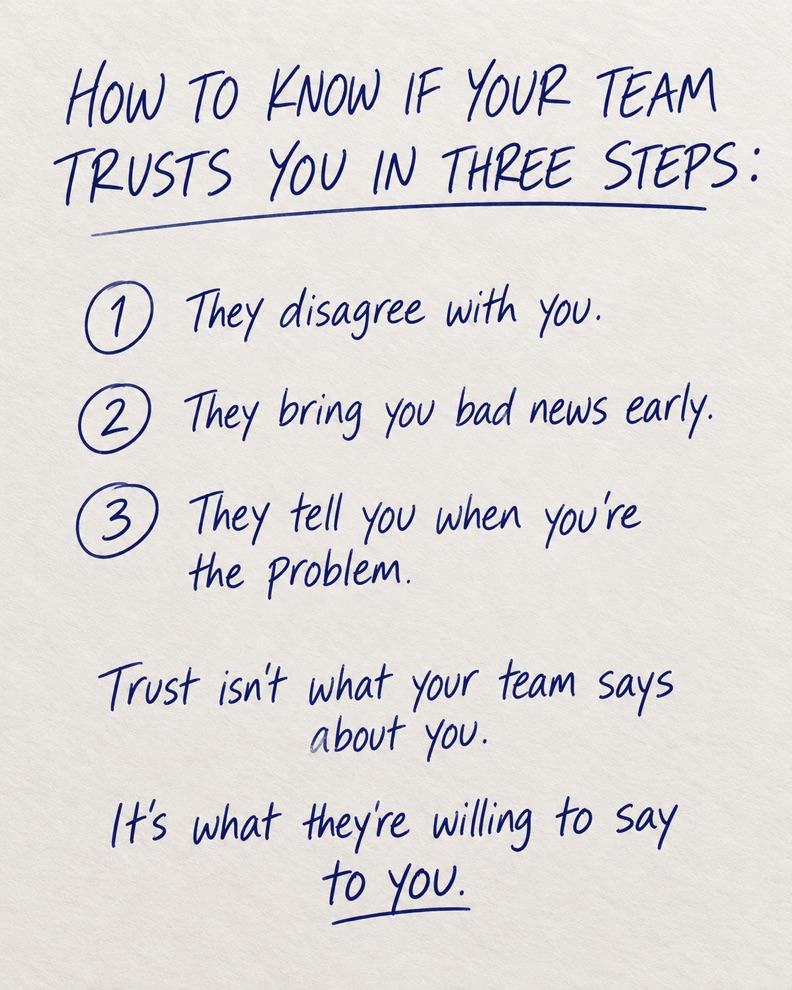
1. They disagree with you
I don’t worry when a leadership team disagrees. I pay attention when nobody does.
Not every decision needs a debate, and some people need time to think. But when concerns consistently surface after the meeting instead of during it, I get curious about what’s making that conversation hard to have in the room.
What to notice: The last time someone challenged your thinking, did you ask what they were seeing? Or did you explain why your approach made sense? Your answer shapes whether they challenge you next time.
2. They bring you bad news early
Before they have all the answers. Before the problem becomes a crisis. Because they expect your first response to be curiosity, not blame.
I’ve worked with leaders who genuinely believed they were approachable, and yet their teams hesitated to bring them problems. Often the leader was moving so fast that every problem was met with an immediate demand for a solution. The intention was to drive accountability. The unintended consequence was that people waited.
When people wait, the cheaper options disappear.
What to notice: When someone brings you bad news without a solution, what’s your first response? Do they leave glad they came early, or wishing they’d waited?
3. They tell you when you’re part of the problem
This is the hardest one. It sounds like:
“Your involvement is slowing us down.”
“We aren’t clear about who actually has decision authority.”
“People hesitate to challenge you because of how you respond.”
I’ve sat on both sides of that table. As a senior executive, I know what it’s like to carry responsibility for decisions and results. As a coach, I see how hard it is for leaders to recognize their impact on the people around them.
A conversation that feels like a normal exchange to you can feel like a career risk to someone whose next role you influence.
Can your team tell you when your behavior is making their work harder? And when they do, can you stay curious long enough to understand their experience before explaining your intentions?
The ten seconds after someone speaks up
In my work with senior executives and leadership teams, I watch what happens immediately after someone raises something uncomfortable.
Someone challenges your decision. You interrupt to clarify your reasoning.
Someone raises a risk. You ask why it wasn’t addressed earlier.
Someone gives you difficult feedback. You explain what you actually meant.
I understand these reactions. When you’re responsible for results, you want to solve problems and keep things moving. That instinct has probably served you well. Meanwhile, the other person is watching your response and deciding whether speaking up was worth it.
The same moments can go differently:
Someone challenges your decision. “Say more. What am I missing?”
Someone raises a risk. “Thank you for bringing this up now. What do you need from me?”
Someone gives you difficult feedback. “That’s important for me to hear. Can you help me understand where you’ve experienced that?”
You won’t get this right every time. Nobody does. What counts is the pattern people experience, and whether you notice and repair the moments when your response shut a conversation down.
You cannot demand honesty and then make honesty costly.
Honesty and accountability work together
Making it safe to speak up leaves your authority intact. You still make the call, set expectations, and hold people accountable.
You can listen carefully, weigh a different perspective, and keep your original decision. What matters is whether the person who spoke up believes their view was taken seriously. When they do, they’re more likely to speak up again, even when the decision doesn’t go their way.
Five questions for this week
Look back at your last few leadership meetings.
- Who challenged my thinking, and how did I respond?
- What bad news reached me early, before someone had a solution?
- When did someone last tell me my behavior was making their work harder?
- Whose perspective was missing from an important decision?
- What might my team be discussing privately that they hesitate to raise with me?
If you struggle to recall specific examples, don’t read that as good news. Ask what isn’t reaching you, and what role your own behavior might be playing.
The conditions behind the behavior
At Better Together Group, I start from a simple chain: leaders create conditions, conditions shape behavior, behavior drives results.
My TACT™ framework names four conditions: Trust, Accountability, Clarity, Truth. Together they shape whether people challenge your decisions, bring you bad news early, and tell you when you’re part of the problem.
These conditions get built in ordinary moments: how you respond when someone disagrees, what happens when a commitment is missed, whether someone can tell you something you don’t want to hear.
One question
Think about the last time someone challenged you. Maybe they disagreed with a decision, brought you bad news, or told you something about yourself that was difficult to hear.
What happened next? And did your response make it easier or harder for them to have that conversation with you again?
Trust isn’t measured by how comfortable people feel agreeing with you.
It’s revealed by how willing they are to tell you something you may not want to hear.